
COPD information
- What is COPD?
- Do I have COPD?
- Signs and symptoms of COPD
- What causes COPD?
- The link between COPD and your heart
- How is COPD diagnosed?
- What is spirometry?
- Tools that track your symptoms
- COPD triggers
- COPD flare-ups
- COPD action plans
- COPD Review
|
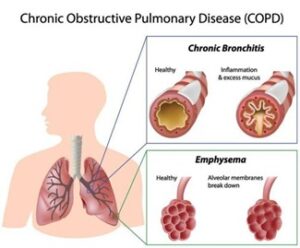
Chronic Obstruction Pulmonary Disease (COPD) is a long-term lung condition characterised by breathlessness, coughing, and increased mucus. This leads to blocked airways (bronchioles) and damaged air sacs (alveoli). Lets break COPD down… Chronic = long term (does not go away) COPD is an umbrella term which includes: COPD is progressive and irreversible. However, with good management and support, people can live long and healthy lives. The main causes of COPD are smoking, exposure to air pollution, or genetic factors like alpha-1-antitrypsin deficiency (emphysema) Chronic Bronchitis – The presence of mucous, swelling and long-term productive cough for three months during two consecutive years when other lung or heart causes for these symptoms have been excluded.
Emphysema – Abnormal, permanent enlargement of the air sacs (alveoli) at the bases of the lungs, accompanied by destruction of their walls and loss of elasticity.
Illustration courtesy of healthflexhhs.com
|
In New Zealand, around 14% of adults aged over 40 years live with COPD. It is a big reason people end up in hospital so early detection, diagnosis, treatment and support is important.
If you think you or someone you care for might have COPD, it’s important to see your doctor as soon as possible. Going through the process of getting a diagnosis will tell you whether your symptoms are being caused by COPD or something else. A diagnosis will help you to manage your condition and understand how to reduce or prevent symptoms such as cough, sputum production, chest tightness and breathlessness. It will also help you learn how to stay well and live a long and healthy life.
COPD symptoms tend to start slowly and can get worse over a few years, so many people may have COPD but don’t yet know they have it.
COPD symptoms are often progressive (get worse), persistent (continue), brought on by exercise and worrying. Some people experience all or only a couple of symptoms. The most common symptoms are:
- Cough
- Sputum/phlegm production
- Shortness of breath/breathlessness
- Recurrent chest infections
At your appointment your doctor will ask you questions about you and your family’s medical history. They will also ask for details about your symptoms (symptoms may include wheeze, cough, mucous production, shortness of breath and chest infections) such as:
- What symptoms you are experiencing and for how long you have been experiencing them
- When symptoms occur
- If there is a family history of COPD (especially emphysema and/or an alpha-1 antitrypsin deficiency)
- Smoking/vaping history (including second hand or passive smoking)
- What you do or did do for work
- What dangerous particles you may have been exposed to in your life and the length of the exposure
- If you have a history of asthma (including if this has been well controlled or not)
- Family history of alpha-1 anti-trypsin deficiency
Your doctor will listen to your lungs with a stethoscope and may order tests for you including:
- Blood tests
- Chest x-ray
- CT scan
- Spirometry
Signs and symptoms of COPD can take a long time to show and become obvious. In the early stages, people often blame their symptoms on smoking, aging or being unfit/out of shape. This can be unhelpful because it delays people seeking help and getting a diagnosis. People with COPD can have the condition for several years and not know about it.
COPD symptoms usually include:
- A daily cough that produces mucous/phlegm
- Excess mucous in your throat and lungs in the morning
- Shortness of breath/breathlessness
- Lack of energy
- Frequent chest infections
Because COPD is irreversible and progressive, symptoms tend to worsen over time. There is no cure for COPD but with the right treatment and support, people can live well.
Smoking tobacco/cigarettes is the most common cause of COPD. Most smokers will get changes in their airways due to the harmful pollutants contained in cigarettes. About half of all smokers will have some airflow problems.
Other causes of COPD include:
- Long-term exposure to vapours, gases, dust, or fumes, indoor and outdoor air pollution, inhaled drugs, and second-hand smoke
- There’s now evidence that vaping (use of e-cigarettes) can cause COPD, even in non-smokers. Recent studies show a 1.5 times higher risk of COPD in people who vape. Read more here: The impact of electronic cigarette use on chronic obstructive pulmonary disease: A systematic review and meta-analysis – Respiratory Medicine
- If you are under 40, your doctor may check for an inherited condition called alpha-1 antitrypsin deficiency. This means your body does not make enough of a protein that protects your lungs, making them more easily damaged, especially if you smoke
- Poorly controlled asthma
Some people get COPD without smoking or obvious exposures. COPD can also happen in people with other lung diseases like asthma. Poor lung growth in young adults raises the risk of COPD later in life.
Your heart and lungs work together to deliver oxygen around your body. If you live with COPD, looking after your heart is an important part of staying well.
People with COPD can be more likely to develop heart disease and heart failure, where the heart does not pump blood as well as it should. New Zealand’s COPD guidelines recommend that people with COPD have a heart health risk assessment.
Why are COPD and heart health connected?
COPD and heart disease share risk factors, including smoking and aging. Inflammation and changes in oxygen levels can also put extra strain on the heart and blood vessels. This means the connection involves more than smoking alone.
The most dangerous time for someone with COPD is after an exacebation. The risk of cardiovascular events after an exacerbation increases markedly:
- Heart attacks/unstable angina – 2x increased risk
- Arrhythmia or heart failure – 3x increased risk
- Ischaemic stroke (blockage in the blood vessels of the brain) – 1.5x increased risk
What can you do?
- Ask your doctor or nurse about a heart health check, including your blood pressure, cholesterol and diabetes risk
- If you smoke, ask for support to stop – this benefits both your heart and lungs
- Keep active – aim for 30 minutes of ‘huff and puff’ each day or whatever is right for you
- Ask your health care team about pulmonary rehabilitation
- Take your medicines as prescribed and have your inhaler technique checked
- Keep your COPD action plan up to date and seek help early when symptoms worsen
Notice changes in your symptoms
New or worsening breathlessness may have more than one cause. Contact your healthcare team promptly if you develop swollen ankles, unusual tiredness or more difficulty breathing when lying down — these can be signs of a heart problem.
A diagnosis of COPD needs to be made by your doctor or other health professional. There can be many possible causes of shortness of breath, cough and wheeze, even if you have been a smoker, so a proper assessment is important to confirm the correct diagnosis so your condition can be treated effectively.
At your appointment your doctor will ask you questions about you and your family’s medical history. They will also ask for details about your symptoms (symptoms may include wheeze, cough, mucous production, shortness of breath and chest infections) such as:
- What symptoms you are experiencing and for how long you have been experiencing them
- When symptoms occur
- If there is a family history of COPD (especially emphysema and/or an alpha-1 antitrypsin deficiency)
- Smoking/vaping history (including second hand or passive smoking)
- What you do or did do for work
- What dangerous particles you may have been exposed to in your life and the length of the exposure
- If you have a history of asthma (including if this has been well controlled or not)
- Family history of alpha-1 anti-trypsin deficiency
Your doctor will listen to your lungs with a stethoscope and may order tests for you including:
- Blood tests
- Chest x-ray
- CT scan
- Spirometry
You may be referred to a respiratory specialist if your GP thinks this is necessary.
To learn more about tools to help track your symptoms, click here.
Spirometry is a breathing test (or lung function test) that measures how much air you can blow out and how quickly you can empty your lungs. It helps your healthcare team check how well your lungs are working and diagnose conditions such as COPD.
What happens during the test?
You take a deep breath in, then blow out as hard and fast as you can through a mouthpiece connected to a machine. You keep blowing until your lungs feel empty. You will repeat this several times, with rest breaks, and a trained health professional will guide you.
You may be given an inhaler to help open your airways, then repeat the test to see whether your breathing improves.
To learn more about what happens during this test, click here.
What do the results tell you?
The results help show whether air is having difficulty moving out of your lungs and if there is an ‘obstrucive’ or ‘restrictive’ pattern to your breathing. Your healthcare team will explain what the results mean for you, alongside your symptoms and medical history.
Before your appointment, you will receive instructions about how to prepare, including whether to pause any inhalers.
To book a spirometry test with Asthma NZ, please click visit our website.
Understanding how COPD affects you
Your experience of living with COPD matters. Two simple questionnaires can help you explain your symptoms to your healthcare team and track changes over time. They are based on how you feel and what you can do — there are no right or wrong answers.
COPD Assessment Test (CAT)
The CAT is a short questionnaire that measures how much COPD affects your wellbeing and everyday life as well as helping healthcare professionals assess disease severity, monitor changes over time, and guide treatment decisions alongside other clinical measures such as spirometry results and exacerbation history . It takes just a few minutes and asks eight questions about:
- Cough, mucus and chest tightness
- Breathlessness when walking uphill or climbing stairs
- Activities around the home and confidence leaving home
- Sleep and energy levels
Each question scores from 0 to 5, giving a total score of between 0 and 40. A higher score means COPD is having a greater impact on your life. Repeating the questionnaire frequently helps you and your healthcare team notice any changes and discuss whether your treatment or support needs adjusting. A change of 2 or more points is something to look out for.
Take the COPD assessment test to see how you are tracking.
MRC Breathlessness Scale
The Medical Research Council (MRC) dyspnoea scale focuses on how breathlessness affects your daily activities. “Dyspnoea” simply means feeling short of breath. You choose the statement that best describes you.
The NZ COPD guidelines use the modified version, called mMRC, which scores from 0 to 4:
|
Grade |
How breathlessness affects you |
|
0 |
You become breathless only during strenuous exercise |
|
1 |
You become breathless when hurrying on flat ground or walking up a gentle hill |
|
2 |
You walk more slowly than others your age because of breathlessness, or stop for breath at your own pace on flat ground |
|
3 |
You stop for breath after about 100 metres or a few minutes on flat ground |
|
4 |
You are too breathless to leave home, or become breathless when dressing or undressing |
What do your results mean?
Both tools help your healthcare team understand what living with COPD is like for you. Your scores are considered alongside breathing tests such as spirometry, your history of flare-ups and a clinical review – they do not provide the whole picture on their own.
A trigger is something that irritates your lungs or makes breathing harder. It may worsen coughing, wheezing, mucus or breathlessness. Sometimes it can lead to a flare-up (when symptoms become worse than usual).
Although COPD cannot be cured, there are things you can do to manage your symptoms, reduce flare-ups and help slow further lung damage.
Common COPD triggers
Everyone is different, but common triggers include:
- Colds, flu and other chest infections
- Smoke and vaping aerosols, including tobacco smoke, other people’s smoke and wood smoke
- Air pollution, such as vehicle exhaust and industrial fumes
- Dust, fumes and strong smells, including workplace dust, paint fumes, perfumes and cleaning sprays
- Weather changes, cold air, extreme heat and high humidity can make breathing harder
- Pollen and mould, these may worsen symptoms for some people, particularly those who also have asthma or allergies.
Stress and anxiety can also make breathlessness feel worse. Other health conditions, such as heart problems, may contribute to breathing difficulties, so tell your healthcare team about new or changing symptoms.
Ways to protect your lungs
- Keep your home and car smoke-free and vape-free – if you smoke, stopping is one of the most effective ways to protect your lungs. Free support is available through Quitline
- Reduce exposure to irritants – choose fragrance-free cleaning products and avoid sprays, dust and fumes where possible
- Plan around air quality and weather – limit time outdoors when air is smoky or heavily polluted, and adjust activities during extreme weather
- Reduce your risk of infection – wash your hands regularly and avoid close contact with people who are unwell where possible
- Ask about vaccinations – your doctor, nurse or pharmacist can advise which vaccinations are recommended for you
- Take your medicines as prescribed – regular treatment and correct inhaler technique help manage symptoms and reduce flare-ups.
Get to know your own triggers
Notice where you are and what you are doing when symptoms worsen. A simple diary can help you spot patterns and discuss them with your healthcare team.
Keep active at a pace that suits you. Becoming breathless during activity does not necessarily mean you are having a flare-up. Your healthcare team can help you find safe ways to exercise and manage breathlessness.
If your symptoms worsen
Follow your COPD action plan and contact your healthcare team early if you become more breathless than usual, cough more, or notice changes in your mucus. You do not need to know the trigger before asking for help.
COPD flare-ups – what are they?
A COPD flare-up happens when your symptoms become worse than usual. Your healthcare team may call this an exacerbation. Symptoms can worsen over hours or days, and you may need extra treatment such as your reliever inhale. Some flare-ups can be serious and require hospital care.
Recognising the signs
Knowing what is normal for you can help you notice changes early. Signs of worsening COPD include:
- Feeling more short of breath than usual
- Coughing or wheezing more
- Bringing up more mucus, or noticing a change in its colour or thickness
- Feeling more tired or finding everyday activities harder
- Needing your reliever inhaler more often
You may need more breaks when walking, or find tasks such as getting dressed or brushing your teeth harder because of breathlessness.
Taking action early
Work with your health care team to create a personalised COPD action plan. This explains your usual treatment, what to do when symptoms worsen, and when to seek urgent help. Keep it somewhere easy to find, such as on your fridge, and share it with your whānau or support person.
If you notice signs of a flare-up, follow your action plan and contact your healthcare team promptly. If your plan includes extra medicines, take them exactly as instructed. If you have access to a ‘back pocket’ script of oral steroids (prednisone) or antibiotics, you need to let your health care team know and arrange a review with them as soon as possible.
You can find a COPD action plan here. Your doctor or nurse can help you complete it.
When to get emergency help
Call 111 and ask for an ambulance if you:
- Are severely short of breath or cannot speak in full sentences
- Notice your lips or face turning blue or grey
- Become confused, unusually drowsy or faint
- Have chest pain or pressure
- Are getting worse quickly or your reliever is not helping
Do not wait for a routine appointment if you are struggling to breathe.
A COPD Action Plan (sometimes called a ‘management plan’ or ‘treatment plan’) is a personalised guide you create with your doctor, or other prescribing health care professional. It is formatted a bit like a traffic light system. Everyone with COPD should have an action plan, whether your COPD is well controlled or not.
It clearly explains:
- Which medicines to take each day
- What to do if your symptoms get worse
- When to seek urgent medical help
- If/when you should use prednisone or antibiotics
- How to manage breathlessness
The person who prescribes your medications is usually responsible for filling the action plan out.
How a COPD Action Plan helps keep everyone on the same page
A COPD Action Plan isn’t just for you – it’s also a guide for the important people in your life.
This is especially important for:
- Work and employers
- Whānau – so they feel confident giving the right medicine or call for help if you are unable to do it yourself
- Sports coaches and clubs – so sports and games remain safe and fun, with a plan in case symptoms worsen
Having a clear, agreed plan means:
- Less confusion in stressful situations
- Faster action during a flare-up
- Peace of mind for you and those around you
- Fewer hospital visits and emergencies.
When was your last COPD review?
Book an asthma review with your doctor, nurse or asthma educator today and stay on top of your asthma management! To learn more about what is involved in a COPD review, click here.
Asthma New Zealand is here to support you and your whanau – if you would like to speak to one of our expert team for FREE, get in touch!
Book a free appointment here
Ph: 0800 227 328
Email: referrals@asthma.org.nz
A COPD review, or check-up, is an appointment with your health care team to discuss your breathing, symptoms and how COPD affects your everyday life. It is a chance to ask questions, check your treatment and find ways to help you stay well and reduce flare-ups.
During your review, your doctor or nurse may check:
- Your symptoms, including breathlessness, coughing, wheezing, mucus and tiredness
- Your everyday activities – how your breathing affects walking, sleep and things you enjoy doing
- Your reliever use – how often you need it and whether it helps
- Any flare-ups – including urgent appointments, hospital visits, or courses of antibiotics or steroid tablets such as prednisone since your last review
- Your medicines – whether they are helping, any side effects and anything making them difficult to take
- Your inhaler technique – to help you get the most from each dose
- Your breathing and lung sounds (and your oxygen level if needed)
- Whether breathing tests are needed, such as spirometry
- Your triggers and ways to reduce their effect on your symptoms
- Smoking or vaping exposure and support to stop smoking if you need it
- Your vaccinations and which ones are recommended for you
- Your activity levels and whether pulmonary rehabilitation, a programme of exercise and education, could help
- Your overall wellbeing including your weight, nutrition, heart health and emotional wellbeing
- Your COPD action plan so you know what to do if your symptoms worsen
- Any extra support you need including whether a specialist referral would be helpful
You may also be asked to complete a COPD Assessment Test (CAT) or a breathlessness scale to help track how you are feeling over time.
Bring your inhalers, spacer if you use one, and COPD action plan to your appointment. Let your healthcare team know what matters most to you and anything you are finding difficult.
Getting Started
Book a COPD review with your doctor, nurse or COPD educator today and stay on top of your COPD management!
Asthma New Zealand is here to support you and your whanau – if you would like to speak to one of our expert team for FREE, get in touch!
Book a free appointment here
Ph: 0800 227 328
Email: referrals@asthma.org.nz